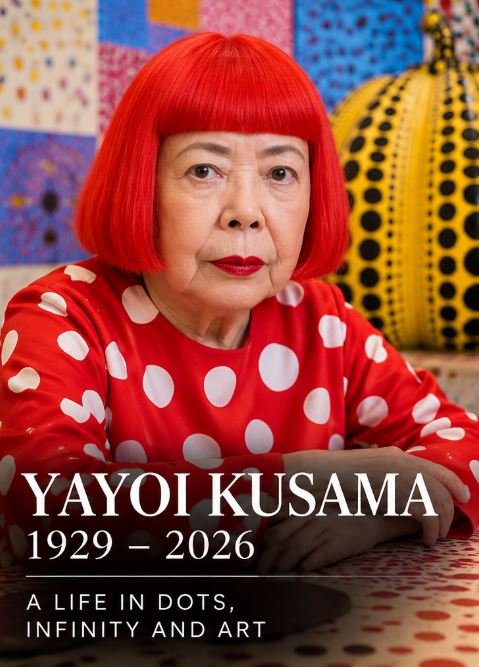
Yayoi Kusama, the Japanese avant-garde artist whose polka dots, pumpkins and immersive mirror installations became instantly recognizable around the world, has died at the age of 97.
Kusama died at a hospital in Tokyo on August 14, 2026, according to an announcement published by the Yayoi Kusama Museum and her official website on August 27. The official announcements confirmed her age and place of death but did not give a cause of death.
Her death marks the end of an extraordinary artistic career spanning painting, sculpture, installation, performance, film, fashion, fiction and poetry. She continued creating art into her final years and became one of the most recognizable Japanese artists of the modern era.
But Yayoi Kusama was more than the artist behind colorful polka dots and Instagram-famous mirror rooms. Her work explored repetition, infinity, identity, obsession and the relationship between the individual and the world around them.
Who Was Yayoi Kusama?
Yayoi Kusama was a Japanese avant-garde artist and novelist born in 1929 in Matsumoto City, Japan.
According to her official biography, Kusama experienced visions and hallucinations from childhood. These experiences became an important source for her early drawings and contributed to the development of the dots and nets that later became central to her artistic language.
She began developing her artistic style in Japan before moving to the United States in 1957. The following year, she began exhibiting innovative works in New York, including paintings, soft sculptures and installations using mirrors and lights.
Over the following decades, Kusama built a career that crossed traditional artistic boundaries. She worked in painting and sculpture but also experimented with performance, fashion, film, literature and large-scale installations.
Yayoi Kusama’s Death and Latest Update
The Yayoi Kusama Museum announced on August 27, 2026, that the artist had died at a Tokyo hospital on August 14 at the age of 97.
The museum and foundation described Kusama as a pioneering avant-garde artist whose creative work covered visual art, performance, fiction and poetry. The statement also said that she continued painting until her final days.
Her official website published a similar announcement, describing her life as one devoted to artistic creation and noting her continuing exploration of themes surrounding love and the soul.
At the time of the announcement, no official cause of death had been publicly disclosed.
The news brought renewed attention to a career that had already made Kusama a global cultural figure.
Why Was Yayoi Kusama Famous?
Yayoi Kusama became famous for an instantly recognizable visual language based on repetition and accumulation.
Her work is particularly associated with:
- Polka dots
- Infinity Nets
- Infinity Mirror Rooms
- Pumpkin sculptures
- Repeated patterns
- Mirrors and lights
- Soft sculptures
- Immersive installations
- Performance art
- The concept of self-obliteration
Repetition was at the center of much of her work. A single dot, repeated thousands of times, could transform an ordinary surface into something that appeared endless.
That idea of endless repetition became one of the defining characteristics of Kusama’s art.
Her work also frequently blurred the boundary between an artwork and the space surrounding it. Instead of simply looking at a painting from outside, visitors to many of her installations became part of the artwork itself.
What Are Yayoi Kusama’s Infinity Mirror Rooms?
The Infinity Mirror Rooms are among Yayoi Kusama’s most famous creations.
These immersive installations use mirrors, lights, repeated objects and enclosed spaces to create the impression of an environment extending far beyond its actual physical boundaries.
The idea developed from Kusama’s experimental mirrored environments in the 1960s. Her official biography notes that after moving to New York she created installations using mirrors and lights, while later in Japan she continued developing the Infinity Mirror Room series.
Inside an Infinity Mirror Room, visitors can see their own reflections repeated again and again. Lights or objects may appear to continue into the distance, creating a powerful visual impression of infinity.
This is one reason Kusama’s installations became so popular with modern audiences. The visitor does not simply observe the artwork—the visitor becomes part of the experience.
Why Did Yayoi Kusama Use Polka Dots?
Polka dots became one of the most recognizable elements of Kusama’s artistic identity.
Her official biography connects her early dot and net drawings with the visions and hallucinations she experienced during childhood. She later developed these repeated forms into a broader artistic philosophy involving infinity, repetition and what she called “self-obliteration.”
The idea behind self-obliteration was closely connected to the disappearance of individual forms within an enormous field of repeated patterns.
A single person, object or surface could appear to lose its separate identity when surrounded by countless similar dots.
This concept allowed Kusama to turn a very simple visual form into a much deeper exploration of space, identity and infinity.
Yayoi Kusama and Her Famous Pumpkins
Pumpkins are another major part of Kusama’s visual identity.
Her pumpkin sculptures transform a familiar everyday object into something strange, playful and highly recognizable through bold colors and repeated patterns.
The pumpkin motif has appeared throughout her career and has become almost synonymous with Kusama’s name.
Her use of pumpkins also demonstrates a broader characteristic of her work: taking an ordinary object and transforming it through repetition, color and scale.
For many people who may not follow contemporary art closely, the bright yellow pumpkins covered with black dots have become one of their first introductions to Kusama.
Yayoi Kusama’s Early Life
Kusama was born in Matsumoto City, Japan, in 1929.
Her interest in art developed at an early age. According to her official biography, the visions she experienced during childhood influenced her first polka-dot and net-themed drawings. She worked with watercolors, pastels and oil paints while developing her own approach to art.
She eventually became dissatisfied with the artistic environment around her and wanted greater freedom to develop her own ideas.
That desire for independence eventually led her to the United States.
Yayoi Kusama in New York
Kusama moved to the United States in 1957 and settled in New York, where she became involved in the city’s rapidly changing avant-garde art scene.
She began exhibiting innovative paintings, sculptures and installations and developed a reputation for working with repetition and accumulation.
Her activities expanded beyond conventional painting. She created soft sculptures, installations, performances, films and fashion-related projects.
Kusama’s work occupied a distinctive position in New York’s art world. It intersected with several important artistic movements of the period without fitting neatly into only one category.
Her experiments with repetition and large-scale environments would later become particularly important to the development of her international reputation.
What Were Yayoi Kusama’s Infinity Nets?
The Infinity Nets were among Kusama’s important early painting series.
Rather than presenting a traditional central subject, these paintings used countless repeated marks across the surface.
The repetition could make the painting appear to continue beyond its physical boundaries.
This approach was fundamental to Kusama’s artistic philosophy. Instead of treating repetition as merely a decorative technique, she turned repetition itself into the subject and structure of the artwork.
The Infinity Nets helped establish the visual language that later appeared in her sculptures, installations and mirror environments.
Yayoi Kusama’s Experimental Art in the 1960s
During the 1960s, Kusama became increasingly involved in experimental art.
Her activities included installations, soft sculptures, performance events, fashion projects and films. She also participated in anti-war and counterculture-related artistic activities.
Her work developed alongside a period of major change in American art.
Artists were challenging conventional ideas about what could be considered art, where art could be displayed and how audiences could participate.
Kusama’s approach to repetition, accumulation and performance placed her firmly within this experimental environment.
Did Yayoi Kusama Influence Andy Warhol?
Yayoi Kusama and Andy Warhol were active in the same New York art environment during the 1960s.
Kusama exhibited alongside artists associated with the emerging Pop Art and Minimalist scenes, and her work attracted attention within the New York avant-garde.
However, it is important not to reduce Kusama’s artistic legacy to her relationship with another famous artist.
Her importance comes from her own innovations in repetition, accumulation, installation, performance and immersive environments.
Her career developed its own distinctive visual language that eventually became recognizable across the world.
Yayoi Kusama and Mental Health
Kusama was open about the connection between her psychological experiences and her creative work.
Her official biography says the visions and hallucinations she experienced from childhood influenced her artistic development.
Her mental health history became an important part of her public biography, but it should not define her entire career.
Kusama was also an exceptionally disciplined and prolific artist who spent decades developing her ideas across multiple forms.
Her work demonstrates how personal experiences can become part of a much larger artistic language.
Why Did Yayoi Kusama Live in a Psychiatric Hospital?
After returning to Japan in 1973, Kusama eventually began living in a psychiatric facility in Tokyo.
Despite this, she continued working as an artist and writer.
Her studio practice remained central to her daily life, and she continued producing paintings, sculptures and installations.
The relationship between her living environment and artistic practice became an unusual but important part of her biography.
Rather than ending her career, her return to Japan marked the beginning of another major phase of her artistic life.
Yayoi Kusama’s Return to International Recognition
Kusama’s international reputation grew substantially from the late 1980s onward.
Her participation in major exhibitions introduced her work to audiences who had not encountered her earlier New York experiments.
The 1993 Venice Biennale was an important milestone in her international recognition.
Over the following decades, major museums increasingly presented her paintings, sculptures and immersive installations.
Her work eventually moved from the specialist contemporary-art world into mainstream global culture.
How Yayoi Kusama Became a Global Cultural Icon
Kusama’s rise to worldwide fame was driven partly by the distinctive nature of her art.
Her bright colors, dots, mirrors, pumpkins and highly immersive installations created experiences that could be understood visually even by people unfamiliar with contemporary-art theory.
The rise of smartphones and social media also transformed the way audiences interacted with her work.
Visitors could photograph themselves inside mirrored environments and share those images online.
As a result, Kusama’s installations became not only museum experiences but also major parts of digital culture.
That helped introduce her work to millions of people around the world.
Yayoi Kusama Museum in Tokyo
The Yayoi Kusama Museum in Tokyo opened in 2017 and became an important institution dedicated to the artist and her work.
The museum presents exhibitions and educational programs related to Kusama’s career.
In 2026, the museum presented KUSAMA’s POP, an exhibition examining the relationship between Kusama’s distinctive visual language and Pop Art. The exhibition was scheduled to run from April 16 through August 30, 2026.
Following the announcement of Kusama’s death, the museum confirmed that the exhibition would continue as scheduled through August 30.
What Are Yayoi Kusama’s Most Famous Works?
Some of the works and series most closely associated with Yayoi Kusama include:
| Artwork or series | Why it is important |
|---|---|
| Infinity Nets | Established her distinctive repetitive painting style |
| Infinity Mirror Rooms | Made immersive mirrored environments central to her global reputation |
| Pumpkin sculptures | Became one of her most recognizable recurring motifs |
| Accumulation series | Explored repetition and accumulation |
| Narcissus Garden | Used repeated reflective forms to explore perception and identity |
| Obliteration Room | Turned audience participation and repeated dots into an immersive environment |
| Dots Obsession | Extended her exploration of circular forms and repetition |
| My Eternal Soul | Represents an important later period in her painting career |
Kusama’s official biography also notes that she worked on the My Eternal Soul series beginning in 2009 and later began the Every Day I Pray for Love series in 2021.
Yayoi Kusama’s Influence on Contemporary Art
Kusama’s influence extends across generations of artists.
She demonstrated that repetition could become a complete artistic language.
Her work also challenged conventional boundaries between:
- Painting and sculpture
- Artwork and environment
- Artist and audience
- Fine art and popular culture
- Personal experience and public expression
Her career crossed many different artistic forms, making it difficult to place her in a single category.
That ability to move between disciplines was one of the defining characteristics of her career.
Yayoi Kusama’s Global Legacy
By the later decades of her life, Kusama had become a global art superstar.
Her work was exhibited by major museums and institutions around the world, while her visual motifs appeared far beyond traditional galleries.
Her appeal crossed generations and cultures.
A major example came from Australia, where a Kusama exhibition at the National Gallery of Victoria attracted more than 570,000 visitors, according to information published by the Kusama organization.
The scale of that audience demonstrates how far Kusama’s work had traveled from the experimental New York art scene of the 1960s.
She had become an artist whose work could attract both contemporary-art specialists and people experiencing museum art for the first time.
What Happens to Yayoi Kusama’s Art After Her Death?
Kusama’s death does not mean the end of her artistic legacy.
Her paintings, sculptures, installations, writings and archives will continue to be exhibited and studied.
The Yayoi Kusama Museum and Yayoi Kusama Foundation will also play an important role in preserving information about her career and presenting her work to future audiences.
Her art is likely to remain highly visible because of the enormous international network of museums, exhibitions and collections associated with her career.
The themes she developed—repetition, infinity, identity, love and the relationship between the individual and the surrounding world—are also likely to continue attracting new audiences.
Why Yayoi Kusama Still Matters
Yayoi Kusama’s importance comes from more than the popularity of her polka dots.
She transformed deeply personal experiences into a visual language that could be experienced by millions of people.
She began with drawings and paintings and eventually created immersive environments in which visitors could lose their sense of scale and space.
Her career also demonstrated that experimental art could eventually reach an enormous global audience without losing its distinctive identity.
Few contemporary artists have achieved a similar combination of avant-garde experimentation, museum recognition and worldwide popular appeal.
A Life Devoted to Art
Yayoi Kusama’s official organizations emphasized that she continued painting until her final days.
That detail reflects the central role art played throughout her life.
From the Infinity Nets to the Infinity Mirror Rooms, from pumpkins to endless fields of dots, Kusama repeatedly transformed her ideas into visual experiences that challenged the way people think about space, identity and infinity.
She died at 97, but the artistic world she created will continue to exist in museums, collections, exhibitions and the memories of the millions of people who experienced her work.
Frequently Asked Questions About Yayoi Kusama
Who was Yayoi Kusama?
Yayoi Kusama was a Japanese avant-garde artist and novelist known worldwide for polka dots, Infinity Nets, pumpkin sculptures and immersive Infinity Mirror Rooms. Her career included painting, sculpture, installation, performance, film, fashion, fiction and poetry.
When did Yayoi Kusama die?
Yayoi Kusama died at a hospital in Tokyo on August 14, 2026, at the age of 97. Her death was announced by her museum and official website on August 27, 2026.
What was the cause of Yayoi Kusama’s death?
The official announcement of her death did not provide a cause of death. Therefore, no specific cause should be presented as confirmed unless her representatives or another authoritative source provides one.
What was Yayoi Kusama famous for?
She was best known for her polka-dot patterns, Infinity Nets, pumpkin sculptures and immersive Infinity Mirror Rooms.
Where was Yayoi Kusama born?
Yayoi Kusama was born in Matsumoto City, Japan, in 1929.
Why did Yayoi Kusama use polka dots?
Her official biography connects her early dot and net drawings with visions and hallucinations she experienced during childhood. She later developed repetition and proliferation into a broader artistic philosophy centered on infinity and self-obliteration.
What are Yayoi Kusama’s Infinity Mirror Rooms?
They are immersive installations that use mirrors, lights and repeated objects to create the visual impression of an apparently endless environment.
Did Yayoi Kusama live in a psychiatric hospital?
Yes. After returning to Japan in 1973, Kusama eventually began living in a psychiatric facility in Tokyo while continuing her artistic and literary work.
Did Yayoi Kusama have an exhibition in 2026?
Yes. The Yayoi Kusama Museum’s KUSAMA’s POP exhibition ran from April 16 through August 30, 2026. The museum confirmed that the exhibition would continue as scheduled after her death was announced.
Why is Yayoi Kusama important to contemporary art?
Kusama expanded the possibilities of painting, sculpture, installation and performance while developing a distinctive visual language based on repetition, accumulation, mirrors and infinity. Her work also helped bring experimental contemporary art to a much wider international audience.
Sources
- Yayoi Kusama Official Website — Biography and official announcements
- Yayoi Kusama Museum — Announcement of her passing
- Yayoi Kusama Museum — KUSAMA’s POP exhibition information