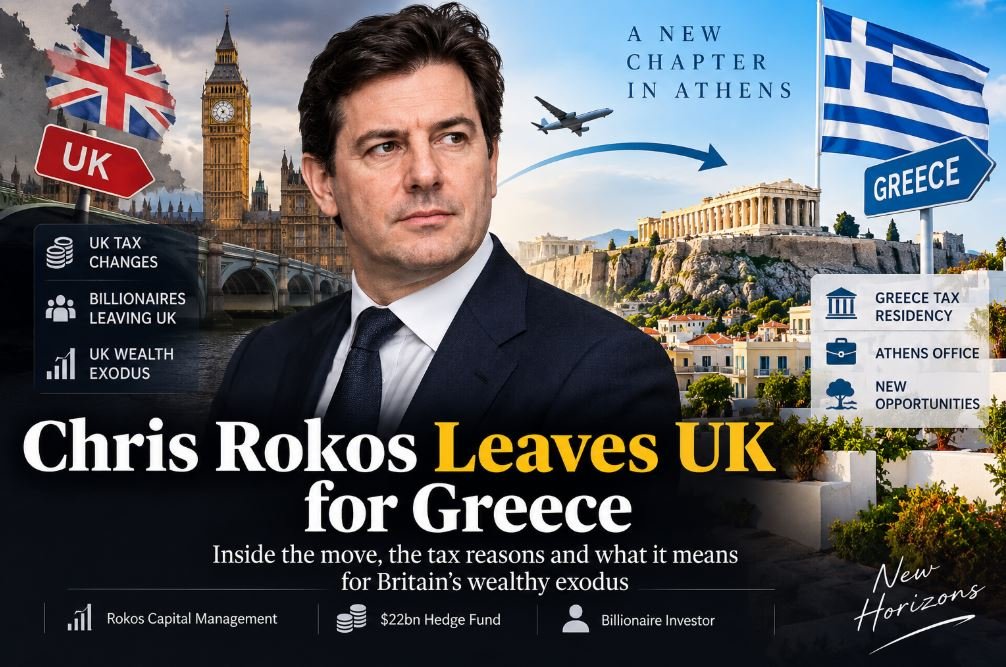
Chris Rokos Leaves UK for Greece: Billionaire Hedge Fund Manager Moves Amid Tax Concerns
Chris Rokos leaves UK headlines have drawn fresh attention to Britain’s growing debate over taxes, wealth and the country’s ability to retain some of its richest residents.
The billionaire hedge fund manager and founder of Rokos Capital Management is reportedly moving his tax residency from the UK to Greece, making him the latest high-profile financial figure to relocate away from Britain.
Rokos is not an ordinary member of London’s financial community. His hedge fund manages around $22 billion, and he was one of Britain’s largest individual taxpayers last year. The move therefore has significance well beyond one wealthy individual’s decision to change his place of residence.
The relocation comes at a sensitive time for the UK, with investors and wealthy individuals watching closely for further tax changes from the government.
Why Is Chris Rokos Leaving the UK?
The precise personal reasons behind Rokos’ move have not been fully detailed publicly, but the decision comes against a backdrop of growing concerns among wealthy UK residents about the country’s tax environment.
The Financial Times reports that Rokos is moving his residency to Greece amid concerns over potential tax increases under the Labour government. His move follows other high-profile departures from Britain by wealthy individuals.
The UK has already made significant changes to the way wealthy internationally mobile individuals are taxed.
One of the most important changes was the abolition of the long-standing non-domiciled tax regime, which had allowed qualifying foreign-domiciled residents to receive favourable treatment on some overseas income.
At the same time, speculation about further increases in wealth-related taxation has added to uncertainty among some investors.
For people with fortunes running into billions of pounds, even relatively small changes in tax policy can have a substantial financial impact.
Who Is Chris Rokos?
Chris Rokos is one of Britain’s best-known hedge fund managers.
He founded Rokos Capital Management (RCM) in 2015 after leaving Brevan Howard, where he had established himself as a major macro trader.
RCM has since grown into one of the world’s significant macro hedge funds, with around $22 billion under management and more than 370 employees globally, according to reports.
Rokos remains closely involved with the firm’s investment decisions and is known for taking large positions based on global economic trends, interest rates, currencies and financial markets.
His success has made him one of the UK’s wealthiest financiers.
How Much Tax Did Chris Rokos Pay in the UK?
One of the most striking aspects of the story is the amount of tax Rokos has paid to the British government.
According to figures reported in connection with the Sunday Times tax rankings, Rokos paid approximately £330 million in UK taxes last year, placing him among the country’s biggest individual taxpayers.
That figure explains why his departure has attracted political as well as financial attention.
If a high-income individual paying hundreds of millions of pounds in tax changes their tax residence, the potential impact on the UK Exchequer can be significant.
However, the actual amount of future tax revenue lost cannot simply be calculated from last year’s figure. Tax liabilities depend on income, investment returns, residence status and future financial performance.
Rokos Reportedly Received £477 Million Last Year
The scale of Rokos’ earnings also highlights why his tax position matters.
The Financial Times reported that Rokos received £477 million last year from his hedge fund after a strong period for the business.
For an individual with this level of income, the difference between tax regimes can potentially amount to tens or even hundreds of millions of pounds.
That makes countries offering special tax arrangements particularly attractive to internationally mobile billionaires.
Why Is Greece Attractive to Wealthy Foreigners?
Greece has developed a tax regime specifically designed to attract wealthy international residents.
Under its special regime for qualifying new tax residents, individuals can pay a flat annual tax of €100,000 on foreign-source income, subject to eligibility requirements.
The regime can also provide significant certainty for wealthy people who have income and investments spread across several countries.
For someone with a very large international investment portfolio, that certainty can be particularly attractive.
Reports indicate that Rokos is relocating to Greece and may establish an office in Athens as part of the move.
Greece therefore stands to benefit from attracting not just an individual taxpayer but potentially additional financial activity and investment.
Is Chris Rokos Moving His Business Too?
It is important to distinguish between Rokos personally changing tax residency and Rokos Capital Management moving its entire operation out of Britain.
The reports concern Rokos’ personal residency.
Rokos Capital Management is an international investment business with a substantial global workforce and operations, and there is no indication that the entire hedge fund is simply shutting down its UK presence.
This distinction matters because London’s financial sector can continue to host a major investment business even if one of its founders becomes resident elsewhere.
What Does the Move Mean for London?
London remains one of the world’s most important financial centres, but the departure of high-profile financiers has renewed questions about its competitiveness.
The UK benefits enormously from its financial services industry through:
- Income tax
- National Insurance
- Corporation tax
- Business activity
- Professional services
- Investment and employment
- Spending by high-income residents
The concern among critics of higher taxes is that wealthy individuals can increasingly choose where they live and pay tax.
A billionaire who can legally relocate to another country has considerably more flexibility than an ordinary UK employee.
The Wider UK Wealth Exodus
Rokos is not the first wealthy individual to leave Britain.
His move comes after several other high-profile billionaires and investors have changed their UK residency or considered doing so.
The wider debate intensified after the government ended the non-dom regime and introduced other tax measures affecting wealthy individuals.
Reports have previously linked departures involving figures including Nassef Sawiris and Lakshmi Mittal to concerns about Britain’s tax environment, although individual circumstances differ.
That makes Rokos’ decision part of a much bigger question:
Is Britain becoming less attractive to internationally mobile wealth?
Labour Government Under Pressure
The story is politically sensitive for the Labour government.
Ministers have repeatedly argued that Britain needs a fairer tax system and that those with the greatest ability to pay should contribute more.
Critics argue that continually increasing the tax burden on wealthy individuals can produce the opposite result if some of those people simply move their tax residence overseas.
The debate is particularly important ahead of future tax decisions, when markets and high-net-worth individuals will be watching for signs of further changes.
What Have Critics Said About Rokos Leaving?
The departure has already attracted criticism from opposition politicians.
Andrew Griffith, the shadow chancellor, argued that losing major taxpayers and wealth creators could ultimately reduce opportunities and leave others facing a greater share of the tax burden.
Supporters of the government’s approach take a different view.
Their argument is that Britain’s tax system should not be designed primarily around keeping billionaires happy and that wealthy individuals should contribute more towards public services.
The disagreement therefore goes beyond Chris Rokos himself.
It is part of a much larger argument over what kind of tax system Britain wants.
Chris Rokos’ Philanthropic Contributions
Rokos’ relationship with Britain is also more complicated than simply that of a wealthy taxpayer.
He has made substantial philanthropic contributions in the UK.
Among his reported contributions is a £190 million donation to Cambridge University, while he has also funded major restoration work at Tottenham House.
That philanthropic record means his departure raises questions not only about tax receipts but also about Britain’s ability to retain wealthy donors who support universities, cultural projects and charitable causes.
Does Leaving the UK Mean Rokos Will Stop Paying UK Tax?
Not necessarily.
Changing tax residence does not automatically remove every UK tax obligation.
The tax treatment of an individual after moving abroad depends on factors including UK-source income, investments, property, business interests and the precise terms of the relevant tax rules.
It is therefore too simplistic to say that Rokos will pay no UK tax at all after moving to Greece.
The significant issue is how much of his future income and investment activity will fall outside the UK’s tax base.
Why This Story Matters Beyond Chris Rokos
The biggest significance of the Chris Rokos leaves UK story is what it says about modern wealth.
Billionaires, hedge fund managers and entrepreneurs can often move between countries much more easily than ordinary workers.
Governments therefore compete for high-net-worth residents by offering combinations of:
- Tax certainty
- Investment incentives
- Business-friendly regulations
- Attractive lifestyles
- Access to international markets
Greece has positioned itself as one of the European countries willing to use tax incentives to attract wealthy foreign residents.
The UK, meanwhile, is trying to balance revenue raising with maintaining London’s status as a global financial centre.
Will Other Billionaires Follow Chris Rokos?
That is one of the biggest questions now facing the UK.
One high-profile departure does not prove that a mass exodus is underway.
However, if more major taxpayers relocate to countries offering significantly more favourable tax arrangements, the cumulative effect could become increasingly important.
The opposite is also possible.
If the UK can maintain its position as a leading financial centre while collecting more tax from wealthy individuals who remain, concerns about a wealth exodus could prove overstated.
Much will depend on future policy and how internationally mobile investors respond.
Chris Rokos Leaves UK: Key Facts
| Detail | Information |
|---|---|
| Person | Chris Rokos |
| Business | Rokos Capital Management |
| Industry | Hedge funds / investment management |
| Reported fund assets | Around $22 billion |
| Reported UK tax paid last year | Around £330 million |
| Reported income from fund last year | £477 million |
| New reported residence | Greece |
| Potential Greek base | Athens |
| Founded RCM | 2015 |
| Previous firm | Brevan Howard |
Figures are based on reporting available on 7–8 September 2026 and may change as further details emerge.
What Happens Next?
The immediate focus will be on whether Rokos formally completes the change in tax residency and how his investment business develops its presence in Greece.
For the UK, the bigger issue will be whether other wealthy taxpayers make similar decisions.
If further high-profile departures occur, pressure on the government to reconsider its approach to wealth taxation is likely to increase.
If departures remain limited, ministers may argue that the UK’s wider economic and financial advantages continue to outweigh the tax differences available elsewhere.
Either way, Chris Rokos leaves UK is likely to remain a closely watched story in London’s financial and political circles.
Final Takeaway
Chris Rokos’ reported move from the UK to Greece is significant because of his extraordinary financial profile.
As the founder of a roughly $22 billion hedge fund and one of Britain’s biggest individual taxpayers, his decision has inevitably become part of the country’s wider debate about taxation and wealth.
Greece is actively competing for wealthy international residents with a tax regime designed to make relocation attractive, while Britain is attempting to raise revenue without undermining its position as a global financial hub.
Whether Rokos’ move becomes an isolated case or another sign of a broader UK wealth exodus will depend largely on what happens next.
For now, the story presents a difficult question for policymakers:
How much tax can Britain impose on internationally mobile wealth before some of that wealth decides to move elsewhere?