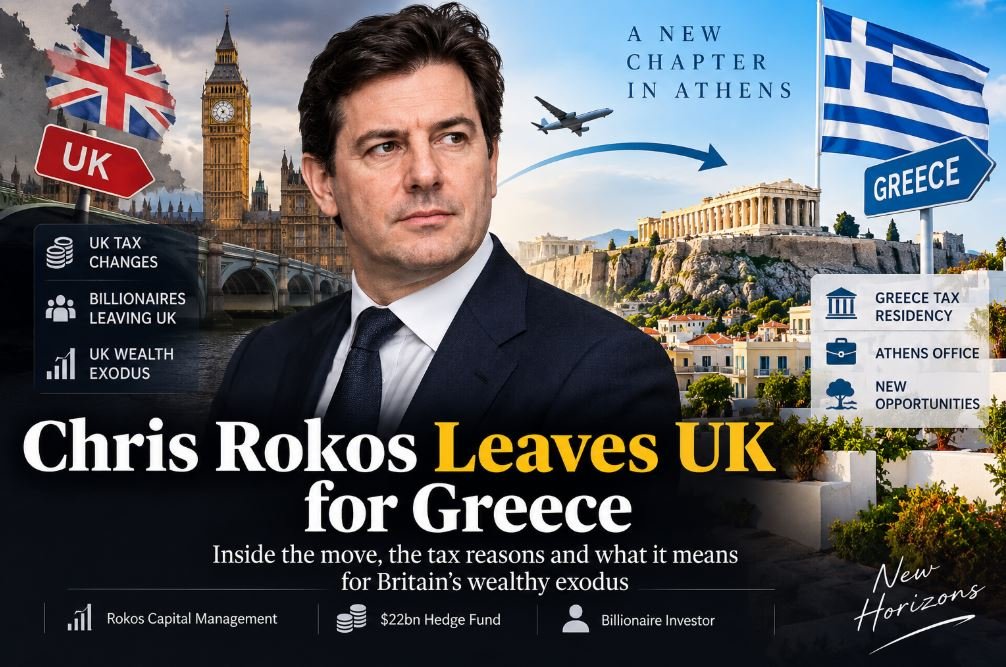
Chris Rokos Leaves UK for Greece: Billionaire Hedge Fund Manager Moves Amid Tax Concerns
Chris Rokos leaves UK headlines are drawing attention across Britain’s financial and political circles after the billionaire hedge fund manager decided to move his tax residency to Greece.
Rokos, the founder of Rokos Capital Management, is preparing to leave the UK and establish a presence in Athens, according to reports from Bloomberg and the Financial Times. His decision makes him the latest high-profile wealthy individual to move away from Britain amid growing concerns over the country’s tax environment.
The move is particularly significant because Rokos has been one of Britain’s biggest individual taxpayers. Reports say he paid around £330 million in tax last year, placing him among the country’s largest taxpayers.
His departure has therefore reignited a wider debate about whether Britain’s tax policies are encouraging wealthy investors and entrepreneurs to relocate overseas.
Chris Rokos Leaves UK for Greece
Chris Rokos is reportedly switching his tax residency from the United Kingdom to Greece.
Bloomberg reported that the hedge fund founder is planning to open an office in Athens as part of the move. The details were described as private by people familiar with the arrangement, while a representative for Rokos Capital Management declined to comment.
The Financial Times also reported that Rokos is moving his residency to Greece, highlighting the growing concern among wealthy individuals about potential future tax increases in Britain.
This does not mean that Rokos Capital Management is leaving London entirely or that its global investment operations are being transferred wholesale to Greece.
Instead, the reported move concerns Rokos’s personal tax residency, alongside plans for an Athens office.
Who Is Chris Rokos?
Chris Rokos is one of Britain’s best-known hedge fund managers.
He founded Rokos Capital Management in 2015 after previously working at Brevan Howard, where he became one of the firm’s leading traders.
Rokos Capital Management has grown into a major global macro hedge fund, managing approximately $22 billion in assets, according to recent reports. The firm employs more than 370 people around the world.
Rokos remains closely involved in the firm’s investment decisions and is regarded as one of the most influential figures in global macro trading.
His personal wealth has also increased substantially through the success of the business. Bloomberg’s estimates have placed his fortune at roughly $4 billion.
Rokos Paid £330 Million in Tax
One of the most striking aspects of the story is the amount of tax Rokos has paid in Britain.
Reports say he contributed around £330 million to the UK tax system last year, making him the country’s third-highest individual taxpayer.
The scale of the figure has made his reported relocation particularly politically sensitive.
Supporters of lower taxation argue that Britain risks losing some of its most successful wealth creators if tax rates and the overall tax burden continue to rise.
Critics, meanwhile, argue that Britain’s wealthiest residents should contribute more to public finances and that the country should not rely on favourable tax arrangements to retain billionaires.
Rokos’s departure puts that argument firmly back in the spotlight.
Why Is Chris Rokos Moving to Greece?
Tax is widely seen as an important factor behind the move, although Rokos himself has not publicly confirmed the reasons for his decision.
Greece has introduced an attractive tax regime aimed at high-net-worth foreign residents.
Under its special regime, qualifying wealthy individuals can pay a €100,000 annual flat tax on foreign income, subject to the relevant conditions. The arrangement can apply for as long as 15 years.
There are investment requirements attached to the Greek regime.
For someone with substantial international investment income, the difference between Britain’s tax system and a fixed-rate regime can potentially be significant.
That has made Greece increasingly attractive to wealthy international residents looking for alternative bases within Europe.
The UK-Greece Tax Difference
The reported move comes after Britain made major changes to its tax treatment of wealthy international residents.
The UK abolished its long-standing non-dom regime, changing the way foreign income and gains are treated for many internationally connected residents.
The reforms were intended to make the tax system fairer and raise additional revenue.
But they have also triggered concerns within parts of the financial industry that Britain could become less attractive to internationally mobile investors.
Greece, by contrast, has actively promoted special tax arrangements designed to attract wealthy foreigners.
This creates an important contrast.
While Britain has moved towards tightening some tax advantages for wealthy international residents, Greece has attempted to use tax incentives as a way of attracting capital and high-net-worth individuals.
Athens Could Benefit From the Move
Rokos’s reported decision could be an important development for Athens.
The city has increasingly sought to position itself as a destination for international investors, entrepreneurs and financial professionals.
The establishment of an Athens office by a major global hedge fund would add to that momentum.
For Greece, attracting someone of Rokos’s financial profile could provide more than tax revenue.
It could also help strengthen the country’s reputation as an emerging European financial centre.
The move demonstrates how competition between countries for wealthy individuals is no longer limited to traditional financial hubs such as London, Switzerland and New York.
Countries including Greece, Italy and the United Arab Emirates have increasingly developed tax and residency programmes aimed at attracting wealthy international residents.
Is Chris Rokos the Only Billionaire Leaving Britain?
No.
Rokos is the latest in a series of wealthy individuals reported to have moved or considered moving their tax residency away from the UK.
The Financial Times has highlighted departures involving other prominent business figures, including Lakshmi Mittal, Nassef Sawiris and Richard Gnodde.
The pattern has become an increasingly important issue in Britain’s debate over taxation and wealth creation.
For critics of the government’s policies, every high-profile departure is evidence that Britain risks damaging its competitiveness.
For the government and supporters of tax reform, however, the argument is more complicated.
They maintain that wealthy individuals should contribute appropriately to public services and that Britain continues to offer major advantages, including its financial infrastructure, legal system, business networks and access to global markets.
What Does Rokos’s Departure Mean for Britain?
The financial impact of Rokos changing his tax residency could be considerable.
If reports of his previous tax contribution are accurate, losing a taxpayer who paid around £330 million in a single year represents a potentially significant loss to the Exchequer.
However, it is important not to assume that the entire amount would automatically disappear from UK tax receipts.
Tax liabilities depend on residency, income, investment structures and the source of earnings, while Rokos Capital Management continues to operate as an international business.
The broader issue is therefore less about one year’s tax bill and more about whether Britain can continue to attract and retain highly mobile global wealth.
Rokos’s £190 Million Cambridge Donation
Rokos’s relationship with Britain extends well beyond finance and taxation.
Earlier this year, he made a £190 million donation to the University of Cambridge to support the creation of a new school focused on government and public policy. The donation was reported as the largest ever gift to a UK university.
That makes his reported decision to move particularly notable.
It demonstrates the unusual position occupied by ultra-wealthy individuals who can simultaneously be major contributors to Britain’s institutions while also having the financial freedom to choose another country as their home.
Rokos has also been involved in a major restoration project at Tottenham House in Wiltshire.
What Happens to Rokos Capital Management?
The reported change in residency does not mean that Rokos Capital Management is shutting down its UK operations.
The company remains a major global hedge fund with operations and employees across different locations.
The key change is understood to be Rokos’s personal tax residency, together with the planned establishment of an Athens office.
The firm has not publicly provided detailed information about the move.
That distinction is important because London’s financial sector is likely to remain central to the firm’s international activities even if its founder spends more time in Greece.
Britain’s Wider Wealth Exodus Debate
The story has arrived at a politically sensitive moment.
Britain is already debating how much additional tax should be collected from wealthy individuals and whether further reforms are necessary.
The government faces pressure to raise revenue while simultaneously trying to maintain the UK’s reputation as a leading global financial centre.
That creates a difficult balancing act.
Higher taxes can increase government revenue from individuals who remain in Britain.
But if wealthy taxpayers relocate, the government may lose some of that expected revenue while also potentially losing investment, business activity and philanthropy.
The extent of that behavioural response is one of the most contested questions in tax policy.
Could More Wealthy Britons Follow?
That remains uncertain.
A decision by one billionaire does not necessarily indicate that thousands of wealthy residents will leave Britain.
However, high-profile relocations can influence how other internationally mobile investors view a country’s tax and business environment.
If Greece and other countries continue to offer attractive residency arrangements, wealthy individuals may have more options than ever before.
Britain therefore faces competition not only from traditional financial centres but also from countries deliberately designing policies to attract high-net-worth residents.
Chris Rokos Leaves UK: What We Know So Far
Here are the key points surrounding the reported move:
- Chris Rokos is moving his tax residency from the UK to Greece.
- He is reportedly planning to establish an office in Athens.
- Rokos founded Rokos Capital Management in 2015.
- The hedge fund manages approximately $22 billion.
- Rokos was among Britain’s biggest individual taxpayers.
- Reports say he paid around £330 million in tax last year.
- Greece offers qualifying wealthy foreign residents a €100,000 annual flat-tax regime on foreign income, subject to conditions.
- His reported move comes after major changes to Britain’s non-dom tax system.
- Rokos has also made major philanthropic contributions in Britain, including a £190 million donation to Cambridge.
What Happens Next?
The most important question is whether Chris Rokos’s move becomes an isolated case or another sign of a wider shift among Britain’s wealthiest residents.
The UK remains one of the world’s most important financial centres, and London continues to attract global investors, banks, hedge funds and entrepreneurs.
But the competition is changing.
For wealthy individuals whose income and assets are internationally mobile, tax residency can be changed far more easily than in previous generations.
Greece’s ability to attract Rokos shows that even established financial centres now face competition from countries offering highly targeted tax incentives.
For Britain, the challenge will be finding a balance between raising enough revenue to fund public services and keeping the country attractive to the investors, entrepreneurs and wealth creators who generate significant economic activity.
Final Verdict
The reported decision that Chris Rokos leaves UK for Greece is significant not simply because one billionaire is changing his country of residence.
It highlights a much bigger question facing Britain: how far can the government increase taxes on wealthy residents before some decide that another country offers a better deal?
Rokos’s reported move to Greece comes at a time when Britain’s tax regime is undergoing major changes and when several other wealthy individuals have already moved abroad.
For Greece, the arrival of a major hedge fund figure represents a significant boost to its ambitions to attract international capital.
For Britain, meanwhile, the story is another reminder that the world’s wealthiest individuals have an increasingly wide choice of where they live, work and pay tax.
The debate over Britain’s future as a global financial centre is therefore unlikely to end with Chris Rokos.